

Planning a trip across multiple European cities involves more than selecting destinations. Travellers also need to decide how to move between them, manage luggage, coordinate accommodation transfers and organise transportation around their itinerary.
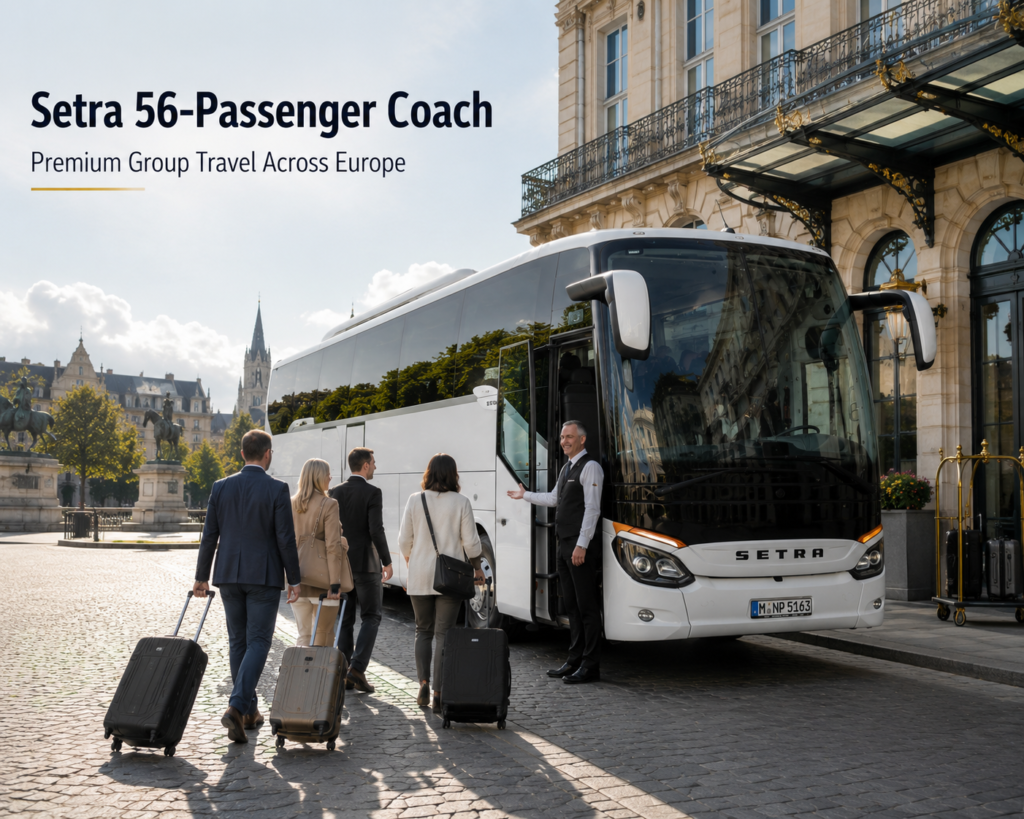
European city-to-city travel can be arranged through several transportation options, including trains, flights, scheduled coaches, private chauffeur-driven vehicles and private touring coaches. Each option serves a different purpose depending on the route, group size, travel schedule, luggage requirements and overall travel preferences.
For example, a solo traveller moving between major railway-connected cities may find train travel convenient, while a family with several suitcases may prefer a private transfer. Similarly, a tour operator managing a group across several countries may consider private coach transportation to keep passengers together.
Tour Passion, a European Destination Management Company (DMC) and transportation provider, supports private transportation requirements across European destinations, including airport transfers, hotel transfers, chauffeur services, group transportation and multi-city journeys.
This guide explains how to compare different transportation options and plan a practical European itinerary.
What Is European City-to-City Travel?
European city-to-city travel refers to travelling between two or more cities within Europe as part of one holiday, business trip, group tour or multi-country itinerary.
A typical itinerary might include:
- Paris to Brussels.
- Amsterdam to Brussels.
- Zurich to Lucerne.
- Rome to Florence.
- Barcelona to Madrid.
- Munich to Vienna.
- Prague to Budapest.
- Luxembourg to Strasbourg.
These are examples of possible city combinations, not recommendations for a particular transport mode. The best option depends on the exact route and travel requirements.
City-to-city travel can involve a combination of different transportation methods. Travellers may take an international train between major cities, arrange a private airport transfer and use a chauffeur-driven vehicle for local transportation.
The objective is to choose transportation that fits the itinerary rather than relying on one mode for every journey.
Which Is the Best Way to Travel Between European Cities?
There is no single best transportation option for every European city-to-city journey.
The most suitable choice depends on the distance, available connections, passenger numbers, luggage, departure schedule and whether travellers need transportation directly between accommodation addresses.
Here is a comparison of the main options.
| Transportation option | Best suited for | Main consideration |
|---|---|---|
| Train | Individual travellers and couples | Railway station access and connections |
| Flight | Longer-distance international journeys | Airport transfers, check-in and baggage |
| Scheduled coach | Budget-conscious travellers | Fixed routes and departure schedules |
| Private chauffeur car | Small private groups | Personalised pickup and drop-off |
| Private minibus | Smaller organised groups | Passenger and luggage configuration |
| Private touring coach | Large groups and tour operators | Route planning, parking and group coordination |
1. Travelling Between Cities by Train
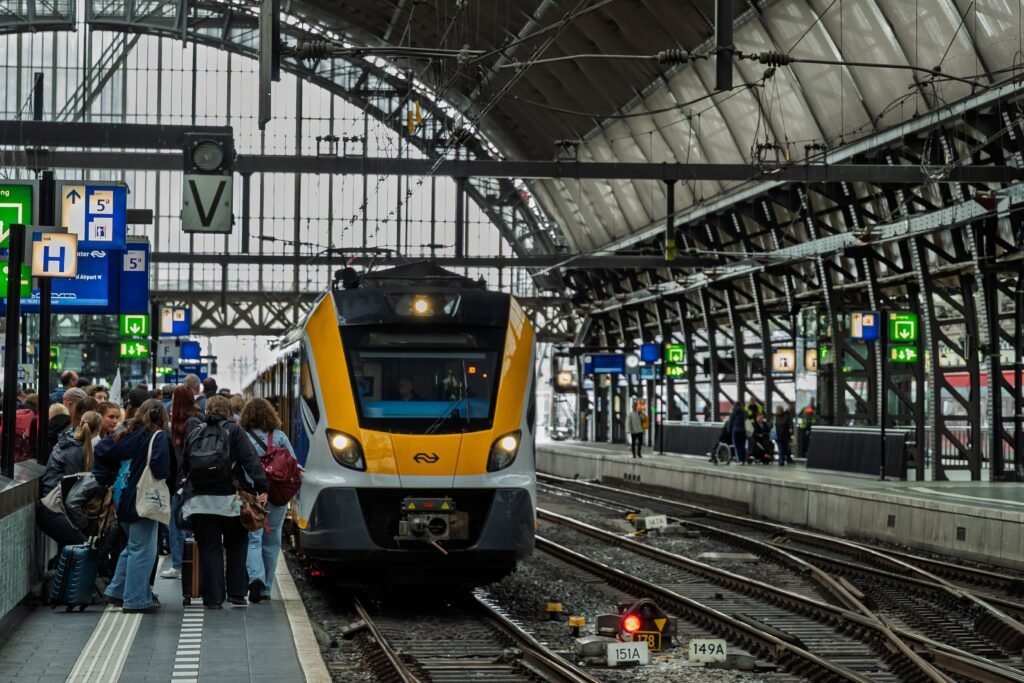
Train travel is an important option for European city-to-city journeys, particularly where direct international or high-speed railway connections are available.
Rail networks connect many major European destinations, making trains suitable for travellers who prefer scheduled departures and city-centre railway stations.
Why consider train travel?
- Connections between many major European cities.
- No airport-style flight check-in process.
- Different seating and ticket categories.
- An opportunity to travel through European landscapes.
- Options for both domestic and international journeys.
What should travellers consider?
Railway stations are not necessarily located next to hotels or final destinations. Travellers may still need a taxi, public transport or private transfer at either end of the journey.
Other considerations include:
- Train departure and arrival times.
- Direct versus connecting services.
- Ticket availability.
- Seat reservations where applicable.
- Luggage handling.
- Railway station accessibility.
- Potential service disruptions.
For travellers with flexible schedules and convenient station access, trains can be a practical choice.
2. Travelling Between Cities by Flight
Flying can be suitable when the itinerary connects cities that are far apart or when a convenient direct rail connection is not available.
For example, a traveller planning a multi-country itinerary involving geographically distant destinations may consider flights for selected sections.
However, comparing flight time alone does not give a complete picture of the journey.
Travellers should also account for:
- Transportation to the departure airport.
- Airport check-in requirements.
- Security procedures.
- Baggage allowances.
- Arrival airport transfers.
- Time required to reach the final hotel.
- Possible delays or cancellations.
A flight that appears convenient on a timetable may involve additional ground transportation at both ends.
For multi-city itineraries, it is useful to compare the complete door-to-door journey rather than only the time spent in the air.
3. Travelling Between Cities by Scheduled Coach
Scheduled intercity coaches are another option for European travel.
They generally operate on predefined routes and departure schedules, making them suitable for travellers who want to book individual passenger seats.
Advantages include:
- Scheduled services between selected destinations.
- An alternative to rail or air travel.
- No requirement to organise a private vehicle.
- Options for individual travellers and smaller parties.
However, scheduled coaches follow their published routes and stops. Travellers may need additional transportation between the coach terminal and their accommodation.
This option is different from private coach hire, where an entire vehicle is arranged for a group according to an agreed itinerary.
4. Private Chauffeur-Driven Transportation

Private chauffeur services can be useful when travellers want transportation between specific pickup and drop-off addresses.
Unlike scheduled public transport, a pre-arranged private vehicle can be requested for an agreed route and schedule.
This can be particularly helpful for:
- Families travelling with luggage.
- Luxury leisure travellers.
- Business executives.
- Small private groups.
- Travellers with multiple hotel stops.
- Passengers requiring airport-to-hotel transportation.
A private chauffeur-driven vehicle can also form part of a wider European itinerary.
For example, a traveller may take a train between two major cities and arrange private hotel transfers at both destinations.
This combination allows travellers to use different transportation options according to the requirements of each journey.
5. Private Minibus and Coach Transportation
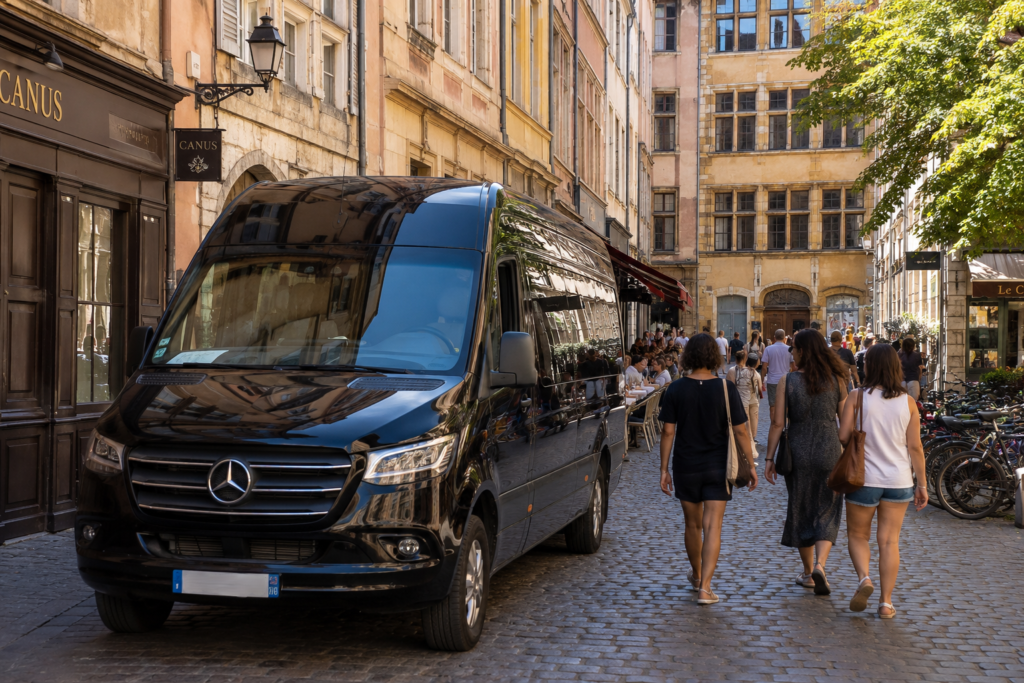
For organised groups, private minibus and coach transportation can be a practical alternative to booking several separate tickets or vehicles.
A private vehicle allows the organiser to coordinate the group’s departure, destination, luggage requirements and planned stops under one transportation arrangement.
Tour Passion’s known fleet configurations include:
| Vehicle category | Known passenger capacity |
|---|---|
| Mercedes V-Class | Up to 8 |
| Mercedes Sprinter | 12 seats |
| Mercedes Sprinter | 16 seats |
| Mercedes Sprinter | 19 seats |
| Larger touring coaches | Approximately 48–67 seats |
| Double-decker coaches | Up to approximately 77 seats |
These are known fleet configurations, not guarantees of availability on every European route.
The correct vehicle should be confirmed according to the passenger count, luggage, travel date, route and local availability.
Private minibus and coach transportation is particularly relevant for travel agents, tour operators, corporate planners and groups travelling between multiple European destinations.
Private Transportation vs Public Transport in Europe
Choosing between private transportation and public transport depends on how the group wants to travel.
Both options have advantages, and they can also be combined within the same itinerary.
| Planning factor | Public transport | Private transportation |
|---|---|---|
| Departure | Published schedules | Agreed pickup schedule |
| Route | Fixed network | Arranged route |
| Pickup | Stations and terminals | Agreed pickup locations |
| Group coordination | Passengers travel according to service arrangements | Group can travel together in the booked vehicle |
| Luggage | Subject to operator conditions and available space | Depends on confirmed vehicle capacity |
| Stops | Scheduled stops | Can be planned into the agreed itinerary |
| Vehicle selection | Operator’s service configuration | Vehicle category requested and confirmed in advance |
| Best suited for | Independent travel | Organised groups and private itineraries |
When Is Public Transport the Better Choice?
Public transport can be preferable when:
- Travelling alone or as a couple.
- A convenient direct connection exists.
- The departure schedule suits the itinerary.
- The hotel is close to the railway station.
- Travellers want to avoid organising a private vehicle.
When Is Private Transportation Worth Considering?
Private transportation may be more suitable when:
- Travelling with a larger group.
- Carrying substantial luggage.
- Visiting several destinations in one day.
- Coordinating airport and hotel transfers.
- Following a fixed group itinerary.
- Travelling with elderly passengers or family members who need a more coordinated arrangement.
- Organising corporate or MICE transportation.
The decision should consider the complete journey rather than comparing ticket prices alone.
How to Plan a Multi-City European Itinerary
A successful multi-city itinerary should have a logical route, realistic travel arrangements and sufficient time at each destination.
Travelling through several cities without considering transportation connections can create unnecessary changes and additional transfers.
Here are some important planning steps.
1. Select Cities According to Geographic Location
Start by identifying the destinations you want to visit.
Try to arrange cities in a logical geographical sequence rather than repeatedly travelling back and forth between regions.
For example:
Western Europe itinerary
Paris → Brussels → Amsterdam → Luxembourg
Central Europe itinerary
Munich → Salzburg → Vienna → Prague → Budapest
Italy itinerary
Milan → Venice → Florence → Rome
These are illustrative route sequences. The best order depends on arrival and departure airports, accommodation availability, railway connections and the group’s interests.
2. Check Transportation Connections Before Booking Hotels
Once the cities have been selected, compare the available transportation options.
Check:
- Direct train availability.
- Connecting railway services.
- Flight schedules.
- Scheduled coach services.
- Private transportation options.
- Arrival and departure locations.
This is important because a convenient hotel location in one city may not necessarily provide convenient access to the departure point for the next journey.
3. Allow Enough Time Between Destinations
Avoid planning every day around transportation.
Travellers need time for sightseeing, meals, check-in and unexpected schedule changes.
For groups, additional time may be required for passenger boarding, luggage loading and coordination.
A realistic itinerary is usually more manageable than one containing too many city changes.
4. Coordinate Airport and Hotel Transfers
One common planning mistake is arranging transportation between cities without considering the first and last stages of each journey.
For example, a traveller arriving at an airport may still need transportation to the hotel before beginning the city-to-city itinerary.
Similarly, after arriving at the final railway station or airport, the group may need a separate hotel transfer.
Consider these connections when calculating the overall transportation requirement.
5. Plan Luggage Requirements
Luggage can influence the best transportation option.
A solo traveller with one cabin bag has different requirements from a family or group travelling with several large suitcases.
Before arranging private transportation, confirm:
- Number of passengers.
- Number of large suitcases.
- Cabin baggage.
- Special equipment.
- Accessibility requirements.
Vehicle seating capacity should never be treated as a guarantee of sufficient luggage space.
6. Consider Cross-Border Travel Requirements
European multi-city journeys frequently involve crossing national borders.
Although many European countries participate in the Schengen Area, travellers should check the applicable entry requirements, travel documents and any temporary border measures for their particular journey.
Transportation organisers should also confirm route feasibility, driver arrangements and relevant operating requirements for international road journeys.
Popular European City-to-City Travel Routes
Europe offers many possible combinations for multi-city travel. The right itinerary depends on the time available, travel preferences and destinations included.
The following examples illustrate how different regions can be connected.
1. Western Europe
Paris → Brussels → Amsterdam → Luxembourg
Suitable for travellers interested in historic cities, cultural attractions and international city breaks.
2. Switzerland and Central Europe
Zurich → Lucerne → Interlaken → Munich
Suitable for itineraries combining Swiss destinations with a visit to Germany.
3. Italy
Milan → Venice → Florence → Rome
Suitable for cultural holidays, city sightseeing and organised group tours.
4. Spain
Barcelona → Valencia → Madrid → Seville
Suitable for travellers exploring different Spanish cities within one itinerary.
5. Central Europe
Prague → Vienna → Budapest
Suitable for cultural sightseeing and multi-country European holidays.
These routes are itinerary examples, not fixed transportation recommendations. Check the actual connections, travel dates and journey requirements before finalising bookings.
How to Choose Transportation for Different Types of Travellers
The best transportation arrangement also depends on who is travelling.
Families and Leisure Travellers
Families may need to consider luggage, children, hotel access and the number of transfers involved.
A combination of trains and private transfers can work well for some itineraries.
Private transportation may be useful when:
- Travelling with children.
- Carrying multiple suitcases.
- Staying outside central railway stations.
- Visiting several destinations within a short period.
- Requiring coordinated hotel pickups.
Luxury Travellers
Luxury travellers may prioritise privacy, a pre-arranged pickup, comfort and flexibility.
Chauffeur-driven transportation can be considered for airport transfers, hotel-to-hotel journeys, private excursions and selected city-to-city routes.
The exact vehicle category and amenities should be confirmed when booking.
Corporate and Business Travellers
Corporate itineraries often involve scheduled meetings, hotel transfers, conference venues and airport transportation.
A private chauffeur or group coach can be useful when the itinerary requires coordinated movement between several locations.
Groups and Tour Operators
Groups often have additional transportation requirements because passengers need to travel according to a common itinerary.
Private minibuses and touring coaches can help organise:
- Group airport transfers.
- Hotel-to-hotel journeys.
- Multi-city sightseeing.
- Intercity transportation.
- Corporate and incentive programmes.
- Multi-country European tours.
Vehicle selection should account for passenger numbers and luggage together.
Why Travel Agents and Tour Operators Need a City-to-City Transportation Plan
For travel professionals, European city-to-city travel involves more than booking transportation between destinations.
It requires coordination between accommodation, arrival schedules, passenger requirements and the overall itinerary.
A well-prepared transportation plan should include the following.
| Planning requirement | What should be confirmed |
|---|---|
| Passenger count | Total passengers, guides and tour leaders |
| Travel dates | Exact dates for every journey |
| Pickup locations | Airports, hotels and railway stations |
| Drop-off locations | Final hotel or destination addresses |
| Vehicle category | Sedan, V-Class, Sprinter or touring coach |
| Luggage | Suitcases and special equipment |
| Route | Cities, stops and border crossings |
| Schedule | Departure, arrival and waiting requirements |
| Driver arrangements | Driving hours and rest requirements |
| Contingency planning | Delays, changes and alternative arrangements |
Avoid Treating Every City Transfer as an Independent Booking
For multi-city programmes, it is useful to review the entire itinerary before arranging individual transfers.
For example, a group travelling from Paris to Brussels and then Amsterdam may require different transportation arrangements for each leg.
The organiser should compare:
- Whether railway connections are convenient.
- Whether a private coach is appropriate for the entire group.
- Whether separate airport or hotel transfers are needed.
- Whether the same vehicle can be arranged across multiple destinations.
- Whether the schedule allows sufficient time for boarding and luggage.
This approach helps identify transportation requirements before the trip begins.
How Tour Passion Supports European City-to-City Travel
Tour Passion is a European DMC and transportation provider supporting travel agents, tour operators, DMCs, luxury travel advisors, corporate planners and organised groups.
For multi-city European itineraries, Tour Passion offers transportation solutions that can be requested according to the route, group size and service requirements.
Relevant services include:
Private Chauffeur Services
Chauffeur-driven vehicles can be requested for private transfers, executive travel, hotel pickups and selected intercity journeys.
Minibus Transportation
Mercedes Sprinter configurations with 12, 16 and 19 seats can be considered for smaller organised groups, subject to availability and luggage requirements.
Private Coach Transportation
Larger touring coaches with approximately 48–67 seats can be considered for group tours, corporate transportation and multi-city travel programmes.
Double-decker configurations are also part of the known fleet range, with larger group capacity.
Airport and Hotel Transfers
Airport-to-hotel, hotel-to-airport and other private transfer arrangements can be requested as part of a wider European itinerary.
Corporate and MICE Transportation
For business delegations, conferences and incentive programmes, transportation can be planned around agreed event schedules and pickup locations.
Multi-City Transportation Coordination
Travel agents and tour operators can share their complete itinerary to discuss the required transportation for each city and intercity journey.
Vehicle availability depends on the destination, date, group size, luggage requirements, itinerary and local operating arrangements. The exact vehicle and configuration should always be confirmed before booking.
The objective is to match the transportation arrangement to the travel programme rather than assume that one vehicle or mode will suit every journey.
European City-to-City Travel Planning Checklist
Before confirming your European itinerary, review these essential points:
- Finalise the cities and their travel sequence.
- Check direct train, flight and coach connections.
- Compare complete door-to-door journeys.
- Confirm hotel locations and check-in arrangements.
- Plan airport and railway station transfers.
- Calculate passenger and luggage requirements.
- Choose the appropriate transportation for each route.
- Confirm cross-border travel arrangements.
- Allow sufficient time for transfers and sightseeing.
- Confirm vehicle availability and booking conditions.
- Keep contact details and contingency arrangements accessible.
A well-organised itinerary combines suitable transportation with realistic travel schedules. It should give travellers enough time to explore each destination without making every day dependent on multiple transfers.
Planning a Multi-City European Trip?
Organising transportation across multiple European destinations?
Tour Passion supports travel agents, tour operators, DMCs, luxury travel advisors and corporate planners with private chauffeur services, minibus transportation, touring coaches and airport transfers across Europe.
Share your destinations, travel dates, group size and itinerary to discuss suitable transportation arrangements.
Email: b2b@tourpassion.com
Phone: +33 1 82 83 60 24
Emergency WhatsApp: +33 7 66 26 04 51
FAQ
1. What is the best way to travel between European cities?
The best option depends on the route, schedule, budget, group size and luggage. Trains are useful for many major city connections, flights can suit longer distances, and private chauffeur or coach transportation can be useful for personalised group travel.
2. Is train travel better than private transportation in Europe?
Not necessarily. Trains can be convenient between well-connected cities, while private transportation offers agreed pickup and drop-off locations. The best choice depends on the complete journey and passenger requirements.
3. Is private transportation suitable for multi-city European tours?
Yes. Private chauffeur services, minibuses and coaches can be requested for multi-city itineraries, depending on vehicle availability, group size, route and operating requirements.
4. Can I travel between multiple European countries in a private coach?
Cross-border private coach transportation can be arranged subject to the route, vehicle availability and applicable operating requirements. The complete itinerary should be shared before booking.
5. Which vehicle is suitable for European group travel?
Smaller groups may consider a Mercedes V-Class or Sprinter, while larger groups may require a touring coach. The final selection depends on passenger numbers, luggage and the destination.
6. Should I book airport transfers separately from city-to-city transportation?
It depends on the itinerary. Airport transfers can be included in a wider transportation programme or arranged separately. Consider arrival times, hotel locations and the next scheduled journey.
7. How can travel agents organise transportation for a multi-city European tour?
Travel agents should prepare the full itinerary, passenger count, travel dates, pickup and drop-off locations, luggage requirements and preferred vehicle categories. This allows transportation requirements to be assessed across the entire programme.
8. Can trains and private chauffeur services be combined in one European itinerary?
Yes. Travellers can use trains for intercity connections and arrange private chauffeur services for airport transfers, hotel pickups and local transportation. Combining different modes can provide greater flexibility when planning a multi-city trip.
Suggested For You
Multi-Country Europe Tour Package – 11 Days
Switzerland France Tour Package – 12 Days
Luxury Transfer Services in Europe
Recommended Europe Travel Services
Paris coach hire,
Paris chauffeur service,
Schiphol airport transfers,
Amsterdam airport taxi,
Paris airport transfer,
Europe coach rental,
Barcelona airport transfers,
Barcelona transportation,
Luxury Europe travel,
Interlaken transfers,
Davos transfers,
Italy chauffeur services,
Paris car rentals,
Grand Paris taxi services,
Paris CDG taxi,
Eco taxi Paris,
Travel trade platform